

Liposomal technology has become an increasingly important consideration for brand owners, contract manufacturers, and product developers seeking advanced ingredient delivery options. By encapsulating an ingredient within a phospholipid bilayer, a well-designed liposomal system can support stability, dispersibility, and bioavailability while creating new opportunities for differentiated supplement formulations.
The word liposomal, however, describes a delivery approach rather than a universal performance standard. The quality of the finished ingredient depends on how the system is engineered, evaluated, and documented. Active loading, particle structure, encapsulation, stability, and dispersibility all influence whether a liposomal ingredient is practical for real-world formulation.
MTC Industries gives formulators access to advanced liposomal ingredients backed by measurable quality standards, transparent sourcing, comprehensive technical documentation, and product-specific research. Beyond its qualified portfolio, MTC can also source customized liposomal solutions for botanicals, vitamins, minerals, and other ingredients.
How Liposomal Technology Supports Ingredient Delivery
A liposome is a microscopic structure formed from phospholipids, the same general class of materials found in cell membranes. Its bilayer can surround or incorporate an ingredient, creating a delivery system that may help protect sensitive compounds and improve their behavior within certain formulations.
The value of liposomal technology depends on the ingredient, the design of the liposomal system, the finished product format, and the evidence supporting that specific product. For formulators, the most useful question is not simply whether an ingredient is liposomal. It is whether the system has been developed and documented to deliver the required formulation performance.
What to Evaluate in a Quality Liposomal Ingredient
Meaningful Active Loading
Active concentration affects serving size, formulation space, and commercial practicality. A useful liposomal ingredient should provide a concentration that supports the intended product format and dosage strategy.
Verified Liposomal Structure
Particle size, morphology, and encapsulation should be evaluated for integrity and consistency. These measures help establish that the ingredient is supported by more than a delivery claim alone.
Formulation Performance
Stability and dispersibility can influence how an ingredient performs across capsules, tablets, powders, beverages, and other delivery formats. The appropriate system should be reviewed within the context of the intended finished product.
Product-Specific Documentation
Clinical, animal, and laboratory studies can provide useful evidence for individual products. Specifications, Certificates of Analysis, technical documentation, and relevant study data should be considered together during ingredient evaluation.
MTC’s Qualified Liposomal Ingredient Portfolio
MTC’s qualified portfolio gives formulators access to multiple liposomal ingredients for antioxidant, healthy-aging, energy, and general wellness applications.
Liposomal Vitamin C 70%
This high-concentration option combines meaningful active loading with a liposomal delivery system designed to support stability and bioavailability. It is relevant for antioxidant, immune-support, healthy-aging, and everyday wellness formulations.
Liposomal L-Glutathione Reduced 50%
Glutathione can be vulnerable to degradation. Liposomal encapsulation helps protect the ingredient while supporting stability and ingredient availability in antioxidant and healthy-aging formulations.
Liposomal beta-NAD+
Liposomal delivery supports ingredient stability and absorption for beta-NAD+, a high-interest ingredient used in cellular energy and healthy-aging product development.
Liposomal CoQ10 50%
CoQ10 is fat-soluble and has limited water solubility. A liposomal format can support dispersibility and formulation flexibility for energy, cardiovascular, and healthy-aging applications.
Liposomal Trans-Resveratrol 50%
Trans-resveratrol is a botanical ingredient with limited water solubility. Liposomal delivery is designed to support stability, dispersibility, and delivery within antioxidant and healthy-aging formulations.
From Delivery Claim to Measurable Performance
Product-specific research helps distinguish a documented delivery system from a general liposomal claim. Liposomal Vitamin C provides one human clinical example.
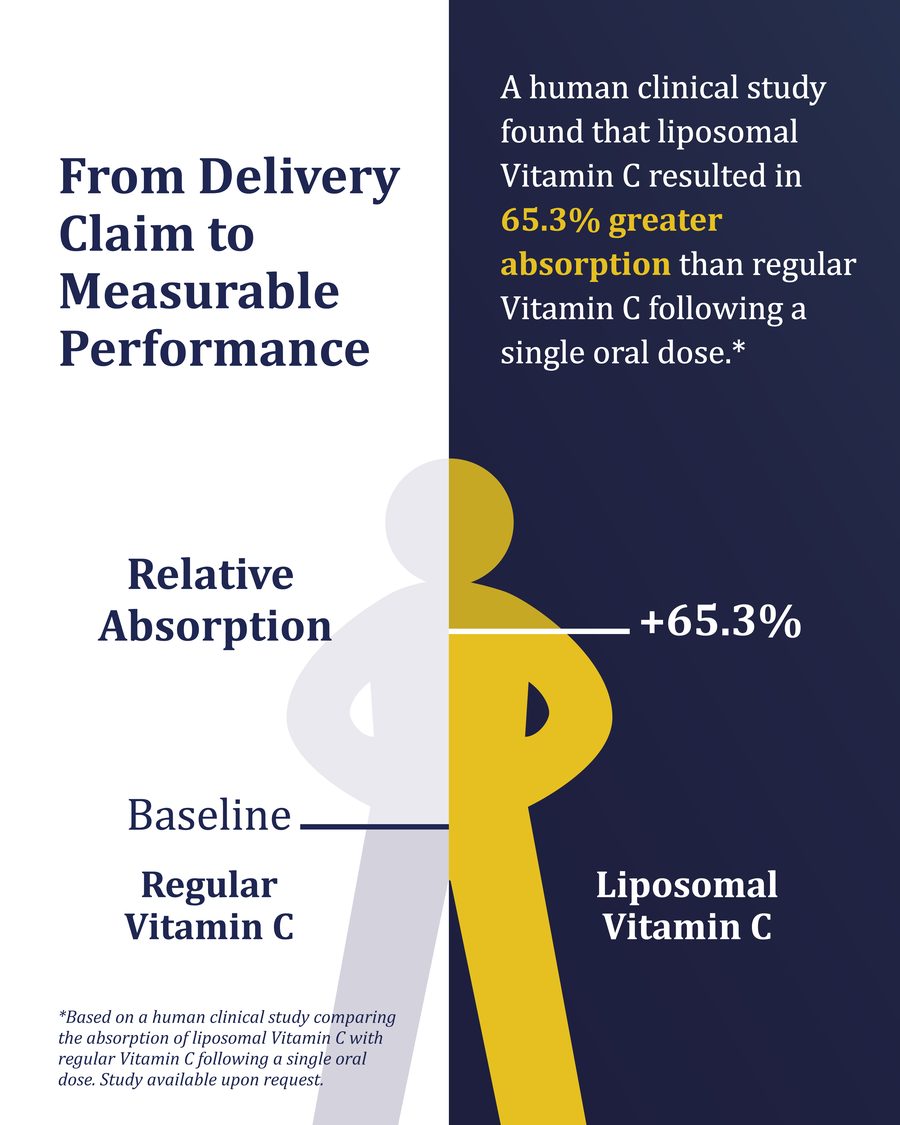
A human clinical study found that a single oral dose of the studied liposomal Vitamin C resulted in 65.3% greater absorption than regular Vitamin C.*
*Based on a human clinical study comparing the absorption of the studied liposomal Vitamin C with regular Vitamin C following a single oral dose. Study available upon request.
Liposomal Solutions Built Around Formulation Goals
Liposomal technology can be applied across a broad range of botanicals, vitamins, minerals, and other functional ingredients. MTC can help customers evaluate qualified portfolio options or source a customized liposomal solution aligned with a specific formulation goal.
That support extends beyond ingredient access. MTC works with brand owners, CMOs, and CDMOs to provide specifications, Certificates of Analysis, technical documentation, samples, pricing, and sourcing support for product development and ongoing supply needs.
Developing a Liposomal Supplement Formulation?
Contact MTC Industries to discuss available liposomal ingredients, customized sourcing, specifications, technical documentation, samples, and pricing.
MTC Industries, Inc.
255 Oser Avenue Hauppauge NY 11788
P: 631-274-4818
Request Liposomal Ingredient Information

We’re here to support your upcoming projects and product pipeline. Thank you for your continued partnership!